 CodeKabir

Code audit
Independent code audit for Laravel, Next.js and PHP applications
Before you extend, fix, sell or hand over an application, find out what is actually in it. I inspect the agreed parts of your codebase and deliver a written report: what is sound, what is risky, how serious each finding is and what to do first.
Who a code audit is for
An audit is worth paying for when an important decision depends on code that nobody involved fully knows.
- You inherited an application. The developer or agency who built it has moved on, and nobody can say with confidence how it works or how fragile it is.
- You are about to build on it. Before a major feature, a growth phase, an investment or a purchase, you want an independent view of what the work will rest on.
- The same problems keep coming back. Fixes take longer each time and bugs return, and you need to know whether the cause is a few hotspots or the structure itself.
- It runs on an old framework or PHP version. Versions that no longer receive security fixes need a plan, and the plan depends on what an upgrade would touch.
- It was built fast, or largely with AI tools. Prototypes, rushed launches and generated code often work well before they are safe to grow. An audit shows which parts need attention first.
- You need a second opinion. Someone has recommended a rebuild or quoted a large fix, and you want an assessment based on the code before you decide.
What the audit examines
The scope is agreed before the audit starts, either the whole application or the parts that matter most. Within that scope, these are the areas examined.
Architecture and maintainability
How responsibilities are split, where business logic lives, duplicated and dead code, and the parts that make every change risky or slow.
Authentication and authorization
How users sign in and, more often the gap, whether every action and every record checks that the current user is allowed to see or change it.
Security-related code checks
Server-side validation, mass assignment, query construction, file uploads, secrets in code or history, and debug or error settings that expose information.
Dependencies and framework support
Outdated and abandoned packages, published security advisories, and whether the Laravel, Next.js, PHP and Node.js versions still receive fixes.
Database logic and migrations
Schema and migration history, constraints and indexes, queries that will not hold up as data grows, and how safely changes can be deployed.
Testing
Whether tests exist for the paths that matter, such as payments, permissions and data changes, and whether they run and actually check behaviour.
Deployment and configuration risks
Environment configuration, how releases are made and rolled back, queues and scheduled jobs, backups, and who controls the accounts.
Performance considerations
Query patterns, caching, rendering strategy and payload sizes that are likely to cause problems as usage grows.
What you receive
A written report that a non-technical decision-maker can follow and a developer can act on.
Each finding states what was found and where, why it matters, how serious it is and what I recommend. Findings are ranked by severity and by their impact on your plans, so you can see what has to happen first, what can wait and what is an acceptable risk.
The report ends with recommended next steps in a sensible order. It is yours to keep: act on it yourself, give it to your current developer, or ask me for a separate quote to address the findings.
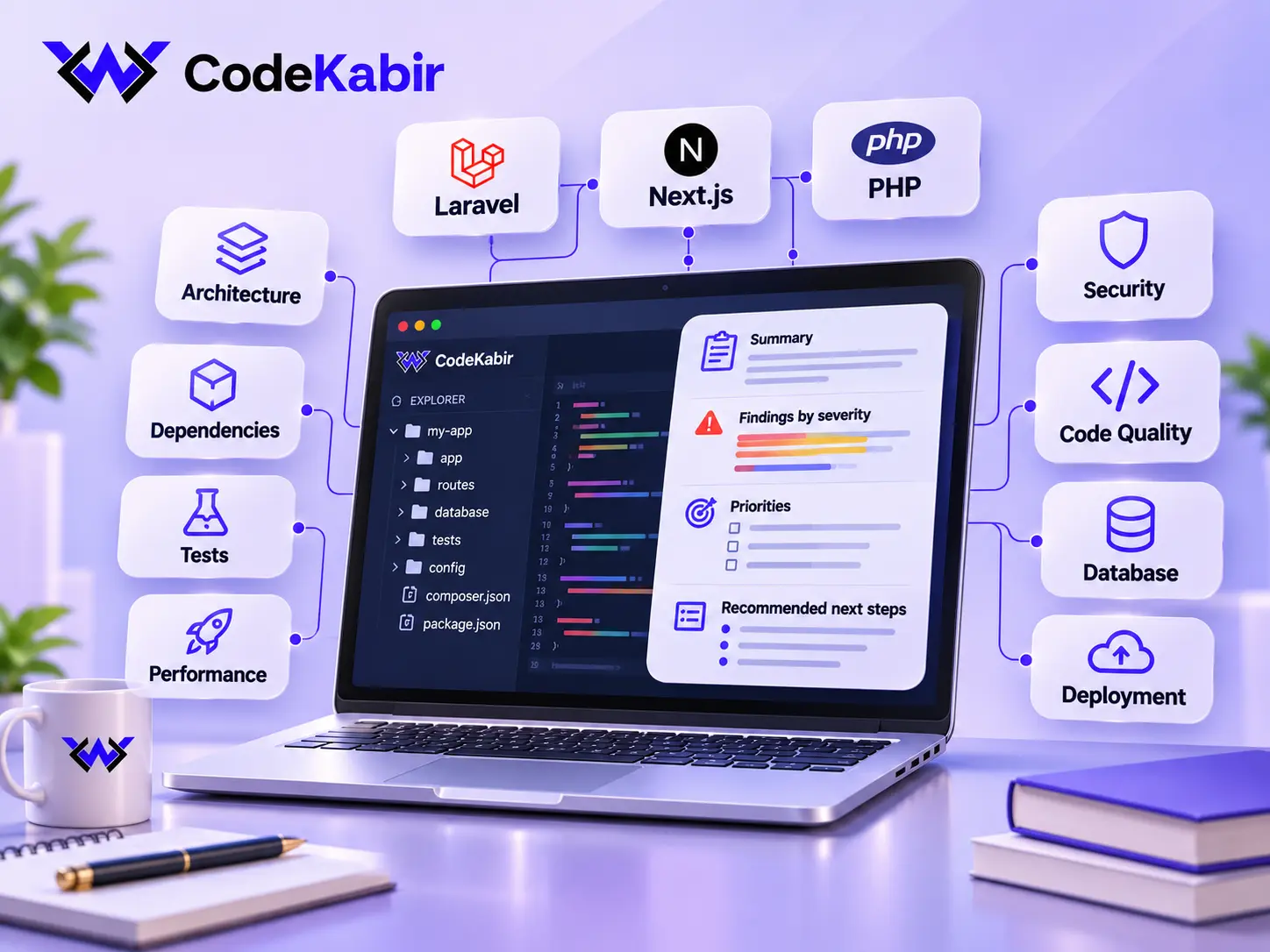
Illustrative report structure
An example of how a report is organised, not taken from a client report. The sections are adapted to the scope you agree.
- Summary. What the application is, what was in scope, and the overall assessment in plain language.
- Scope and method. What was inspected, what was not, and the versions and environment the findings apply to.
- Findings by severity. Each finding with its location, why it matters, how serious it is and the recommended change.
- Dependencies and framework support. The versions found and whether they still receive security fixes.
- Priorities. What to address first, what can wait and what can reasonably be accepted, with the reasoning.
- Recommended next steps. The order of work that fits your plans, whether that is a launch, an upgrade, new features or a handover.
How the audit works
Request a quote
Describe the application: what it does, the stack, roughly how large it is, and what prompted the audit. A short description is enough to start.
Agree scope and price
We agree what will be inspected, the whole application or the parts that matter most, what access is needed, and the price for that scope before any work starts.
Inspection
I inspect the agreed parts of the application. An audit reads and runs the code; it does not change it.
Written report
You receive a report describing the findings, their severity, the priorities and the recommended improvements.
Optional fixes, quoted separately
If you want the issues addressed, I can quote for that work separately. The report is yours to use with any developer.
Technologies covered
Audits focus on the stacks I build and maintain day to day.
- Laravel. Applications, APIs and back ends, including queues, scheduled tasks, packages and the PHP version underneath.
- Next.js and React. App Router and Pages Router projects, Server Components and Server Functions, route handlers, environment variables and rendering choices.
- PHP. Custom PHP applications and PHP code that extends platforms such as WordPress, WooCommerce and PrestaShop.
The same stacks are covered by my development services, so a finding can turn into a fix without changing hands: see Laravel development and upgrades and Next.js and React development.
If the application was built mainly with AI coding tools or an app builder and you already know it needs repairing, the service for fixing and stabilising AI-generated applications combines the review with the fixes. If it uses a stack not listed here, mention it in your request and I will tell you whether it is a fit.
Code audit, code review, security audit or penetration test?
The four are often confused. They answer different questions and produce different results.
| Question it answers | What is examined | Result | |
|---|---|---|---|
| Code audit | What state is this codebase in, and what should be done first? | A broad assessment of an existing application: structure, risks, dependencies, tests and deployment. | A prioritised findings report. This is the service on this page. |
| Code review | Is this particular change ready to merge? | A pull request or a set of changes, as part of everyday development. | Comments on that change, not an assessment of the whole application. |
| Security audit | Does the application meet a defined set of security requirements? | Security controls checked against a standard, sometimes including infrastructure and processes. | A formal assessment against that standard. Not offered here. |
| Penetration test | Can an attacker exploit the running system? | Authorised, simulated attacks against a deployed environment. | Evidence of exploitable weaknesses. Not offered here. |
This service is a code audit. It includes security-related code checks, but it is not a penetration test, a formal security certification or a compliance assessment, and it cannot guarantee that every vulnerability has been found. If you need one of those, the audit report is a useful starting point for it.
How scope and price are set
There is no fixed price list, because the work depends on the application. The price is agreed for a defined scope before the audit starts.
What affects the scope
- The size and age of the codebase
- How many parts are in scope: back end, front end, background jobs, integrations
- Whether documentation, tests or a staging environment exist to start from
- How the application can be run for inspection
- Any deadline, such as an investment, a launch or a handover
You receive the scope and the price in writing before any work starts. The audit price covers the inspection and the report. Fixes are not included; if you want them, they are quoted separately once the report shows what needs doing.
For a sense of what the audit itself involves, the guide on how to audit a codebase walks through the checks step by step.
After the audit: optional fixes and improvements
Nothing in the report commits you to further work with me. If you want help acting on it, these are the usual next steps, each quoted separately.
- Fixing the priority findings. Addressing the issues the report ranks first, on a branch and with tests, quoted as a separate piece of work.
- Framework and PHP upgrades. Moving the application to supported versions one step at a time, when the report shows that is the main risk.
- Tests around critical paths. Adding tests where the report found the most important behaviour unprotected.
- Taking over the application. Becoming the developer responsible for it, with the report as the shared starting point.
What to include when you request a quote
- What the application does and who uses it
- The stack, with versions if you know them
- Roughly how large it is, and whether it has documentation or tests
- Why you want an audit now, and which parts matter most to you
- Any deadline, such as an investment, a launch or a handover
A short description is enough to start. I will reply with questions or a proposed scope, and you decide whether to go ahead once you have the price.
Request a QuoteQuestions about code audits
Common questions about what a code audit covers, what it does not, and how the scope and price are agreed.
What is a code audit?
An independent, structured review of an existing application's code and setup. It establishes the current state, meaning what is sound, what is risky and what is missing, and ends in prioritised recommendations. It describes the code as it was when the audit took place.
Will the audit find every bug and vulnerability?
No, and no honest audit can promise that. It examines the agreed scope with the checks described on this page and reports what it finds. Some problems only appear under real traffic, with particular data or during a targeted attack, which other kinds of testing address.
Is this a penetration test or a compliance assessment?
No. The audit includes security-related code checks, but it is not a penetration test, a formal security certification or a compliance assessment.
How much does a code audit cost?
It depends on the scope. Once you have described the application, we agree what will be inspected and the price for that scope before any work starts. There is no public price list.
Are fixes included?
No. The audit ends with the written report. If you want the findings addressed, I can quote for that work separately, and you are free to use the report with any developer.
What access is needed?
It is agreed together with the scope, and depends on what will be inspected. An audit reads and runs the code; it does not change your code or your infrastructure.
Can you audit an application built with AI tools?
Yes, if it uses a stack listed on this page and the code can be accessed. If it was built mainly with AI tools and you already know it needs repairing, the service for fixing AI-generated applications combines the review with the fixes.
Is my code kept confidential?
Yes. I do not publish client names, code, internal systems or technical details without permission.

Need an independent view of your application?
Describe the application and what prompted the audit. I will reply with questions or a proposed scope and price.
Request a quote
Tell me what you want to build, fix or improve. I'll read your message, ask any questions I need, and reply with next steps or a first estimate. There's no public price list: every quote is based on your actual project.
- Phone+212 671 855 177
- LocationMarrakech, Morocco