 CodeKabir
Laravel development
Freelance Laravel developer for back ends, APIs and existing applications
I build and maintain Laravel back ends: the business logic, data, APIs and integrations an application depends on. Much of the work is on applications that already exist and need fixing, extending or upgrading. You work directly with the developer, not an agency.
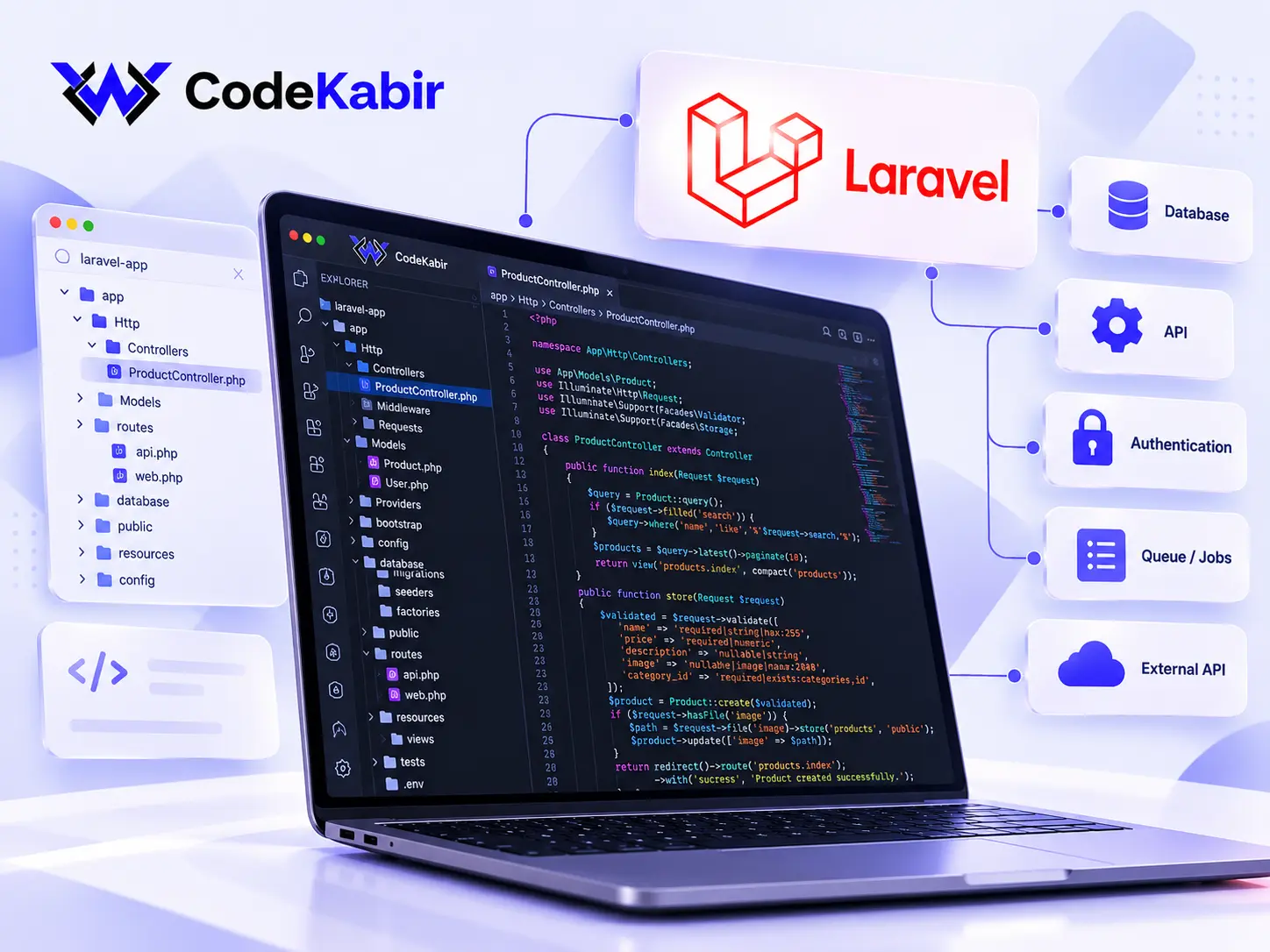
Laravel development work I take on
Existing Laravel applications
Taking over an application someone else built: understanding it, fixing what's broken and adding features without destabilising what already works.
Custom back-end development
Business logic, data models, background jobs, scheduled tasks, notifications, roles and admin panels for applications built around your processes.
Laravel API development
APIs for a mobile app, a separate front end or partner systems, with authentication, validation, versioning and documentation.
Integrations with other systems
Connecting a Laravel application to third-party services and internal systems, so data moves between them without manual re-entry.
Laravel upgrades
Moving an application from an older Laravel and PHP version to a supported one, with dependencies updated and behaviour preserved.
Database-heavy applications
Schema design, migrations, reporting queries and performance work for applications where the data is the business.
Taking over an existing Laravel application
When the original developer has moved on, the first job is understanding the application before changing it. A review usually covers four things:
- Get it running. Set the application up locally or on staging, with its database, queues and environment, so it can be changed safely.
- Map the code. Routes, models, jobs, scheduled tasks, packages and any existing tests: what the application does and where the risky parts are.
- Check versions and dependencies. Which Laravel and PHP versions it runs, which packages are outdated or abandoned, and what that means for security.
- Report and estimate. You get a short written summary of what I found, what I'd fix first and what your requested changes would take.
The result is a clear picture of what you have, so decisions about fixes, new features or an upgrade are based on facts rather than guesses.
Laravel upgrades
Every Laravel release has a limited support window for bug and security fixes, and the PHP version underneath it does too. An application that stays on an unsupported version keeps working, but it stops receiving security patches and gradually becomes harder to change as packages drop support for it.
An upgrade starts with the dependencies: which packages have compatible versions, which are abandoned and need replacing. The application is then moved forward one major version at a time, with tests added around the critical paths if they don't exist yet, and verified on staging before release. For large gaps, the upgrade can be split into stages that are each released separately.
Laravel API development and integrations
An API is needed when something other than your Laravel application has to use its data: a mobile app, a separate front end, a partner's system or your own internal tools.
What a reliable API has to handle
- Authentication. Who or what is allowed to call the API, with tokens that can be revoked and permissions per client.
- Failure handling. External services go down. Calls to them run in queued jobs with retries and logging, so a timeout doesn't lose an order or a record.
- Idempotency. The same request arriving twice, from a retry or a double click, shouldn't create two records or charge twice.
- Versioning and documentation. Other teams can rely on the API without breaking when it evolves, because changes are versioned and documented.
Integrating with other systems
Integrations go the other way: your Laravel application calls a payment provider, an accounting tool, a logistics service or another company's internal API. The same rules apply: queued calls, retries, logs you can read and a clear record of what was sent and received.
I have built integrations with third-party services and with private, internal APIs. Some of that work is confidential, so it isn't described here, but I can discuss comparable experience privately.
A Laravel API can also serve a separate front end. If you need a fast public site or app on top of it, see Next.js development.
Business logic that stays maintainable
The difficult part of most business applications isn't the framework, it's the rules: pricing, approvals, statuses, permissions, calculations. When those rules are scattered across controllers and views, every change becomes risky.
I keep business rules in dedicated, testable classes, move slow work (imports, exports, emails, external calls) to queues, and design the database with migrations so its history is versioned like the code. For you, that means changes cost less over time and another developer can pick the project up later.
How a Laravel project works
Access & review
Repository and staging access, then a review of the code and the setup before any estimate.
Findings & quote
A written summary of the current state, the proposed approach, a timeline and the quote.
Development
Work in a separate branch with tests on the critical paths, so changes are reviewable and reversible.
Staging & review
You test on staging with realistic data before anything reaches production.
Deployment & follow-up
Release with database migrations planned, then monitoring of logs and queues after it goes live.
Laravel development questions
Common questions about Laravel development, existing applications, API work, upgrades and how back-end projects are scoped and maintained.
Can you work on a Laravel application another developer built?
Yes, and it's a large part of Laravel work. I start with a review so that the estimate reflects the real state of the code, including any parts that need fixing before new features can be added safely.
Our application runs an old Laravel version. Do we have to upgrade?
Each Laravel release only receives security fixes for a limited period, and older PHP versions lose support too. Staying on an unsupported version gets riskier over time. I can assess what an upgrade involves for your application and whether to do it in one go or in stages.
Can you work as a Laravel consultant rather than build everything?
Yes. Code reviews, architecture advice, upgrade planning or helping your team with a specific problem are all possible as smaller, separate engagements.
Do you build the front end as well?
Yes. That can be Blade or Livewire inside the Laravel application, or a separate React or Next.js front end that talks to a Laravel API.
Can you integrate with a private or internal API?
Yes, given access to its documentation and a test environment. Some of my integration work is under confidentiality, so I don't publish client systems or endpoints, and the same applies to yours.
How much does a Laravel project cost?
It depends on the scope and on the state of the existing code, so I don't publish prices. After a review, you get a quote for the specific work.

Have a Laravel application that needs work?
Send a short description and, if you can, the Laravel version it runs. I'll reply with questions or next steps.
Request a quote
Tell me what you want to build, fix or improve. I'll read your message, ask any questions I need, and reply with next steps or a first estimate. There's no public price list: every quote is based on your actual project.
- Phone+212 671 855 177
- LocationMarrakech, Morocco